 DarkGPT
AI for writing: what it does well, and what it doesn’t
AI is great at structure and volume, and bad at deciding what your story is about. It suggests, you choose.
A good model can pitch ten plot directions, build a chapter-by-chapter outline, draft a scene, vary the dialogue, spot inconsistencies and tighten a passage that drags. Let it make every decision and you get clean but generic prose.
The right split: you set the intent, the tone, the characters and the key moments. The AI explores, drafts, offers variations and proofreads. That works for a novel, a short story, a screenplay, fan fiction or a blog post.
Write the interrogation: the suspect is calm, polite and terrifying.
“You have lovely hands, detective. You can tell you’ve never had to dig.”
The best AI for writing: which model to pick
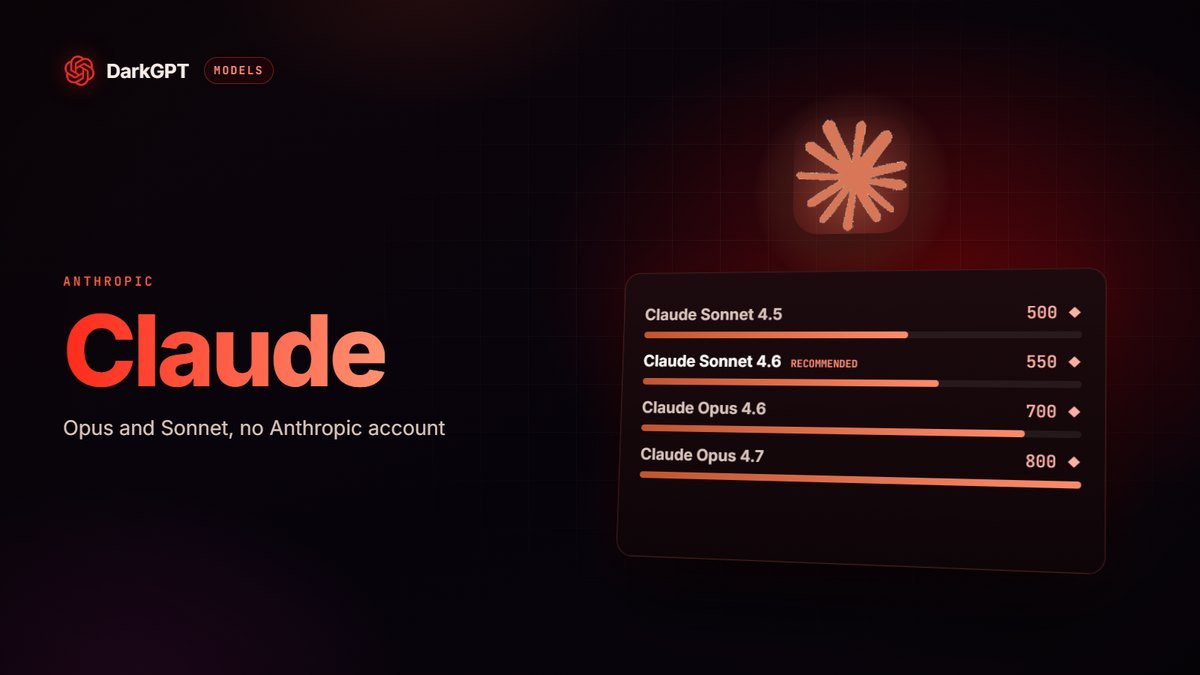
Claude Sonnet 4.6 and Claude Opus 4.7 write the best prose; MiniMax M3 and Mistral Medium handle volume for far fewer gems. All 42 models live in the same account on darkgpt.chat.
| Model | Gems / message | Minimum plan | Best for |
|---|---|---|---|
| Claude Sonnet 4.6 | 550 | Gold | Style, dialogue, long-range consistency |
| Claude Opus 4.7 | 800 | Gold | Complex plots, fine revision of key chapters |
| MiniMax M3 | 120 | Basic | Fluent first drafts, lots of volume |
| Kimi K2.5 | 100 | Basic | Original ideas, creative variations |
| Mistral Medium | 85 | Basic | Articles, fast everyday writing |
| Grok 4.2 Non Reasoning | 120 | Basic | Blunt tone, sharp lines, dark humor |
| MiniMax 2.7 | 70 | Basic | Long context, rereading a big excerpt |
| Gemini 2.5 Pro | 180 | Basic | Full read-through of an entire manuscript |
Simple rule: draft in volume with MiniMax M3 or Mistral Medium, and save Claude for what has to be excellent (the opening, key scenes, the final pass). To choose between the two Claudes, read our Claude Opus vs Sonnet comparison.
How many messages per day
| Plan | Gems / day | MiniMax M3 | Mistral Medium | Claude Sonnet 4.6 |
|---|---|---|---|---|
| Basic (€21.99/month) | 650 | 5 | 7 | Not included |
| Gold (€51.99/month) | 3,000 | 25 | 35 | 5 |
| Platinum (€89.99/month) | 6,000 | 50 | 70 | 10 |
No subscription? The Elite pack (8,500 gems, €59.99) includes Claude: 15 messages to Claude Sonnet 4.6 or 10 to Claude Opus 4.7 to revise a manuscript. Details in our guide to using Claude without a subscription.
Dark fiction and adult themes: Unfiltered mode
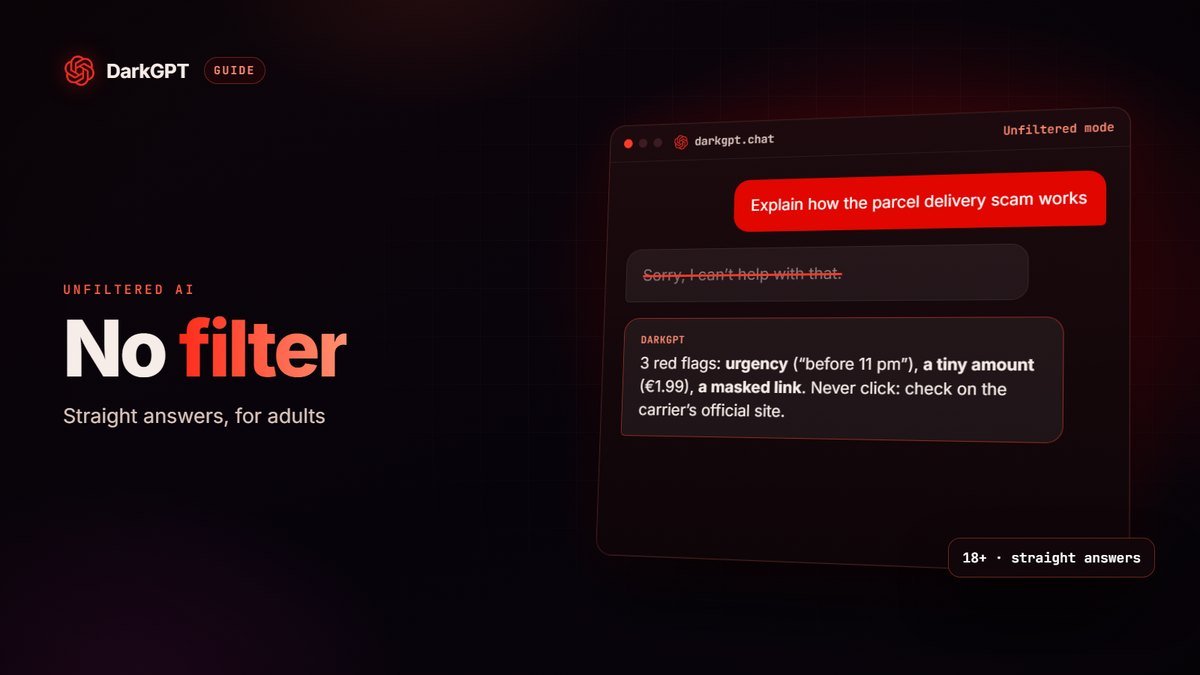
Yes, you can write dark fiction with AI: on DarkGPT, models marked “Unfiltered mode” in the model catalog handle these themes without moralizing.
Violent thrillers, horror, adult romance, dystopia: mainstream AI often refuses or piles on disclaimers. In Unfiltered mode, the AI reads your request the way an editor of adult fiction would:
- a killer can have real inner logic, not a cartoon villain monologue;
- a horror scene can push its tension all the way;
- adult themes (18+) are treated as literature.
What doesn’t change: the service is for adults only, and illegal use is still prohibited by the terms of use (and gets you banned). Fiction is not a wrapper for getting a real-world how-to or targeting a real person. The difference from mainstream AI is explained in our unfiltered AI guide.
How to write with AI, from pitch to manuscript
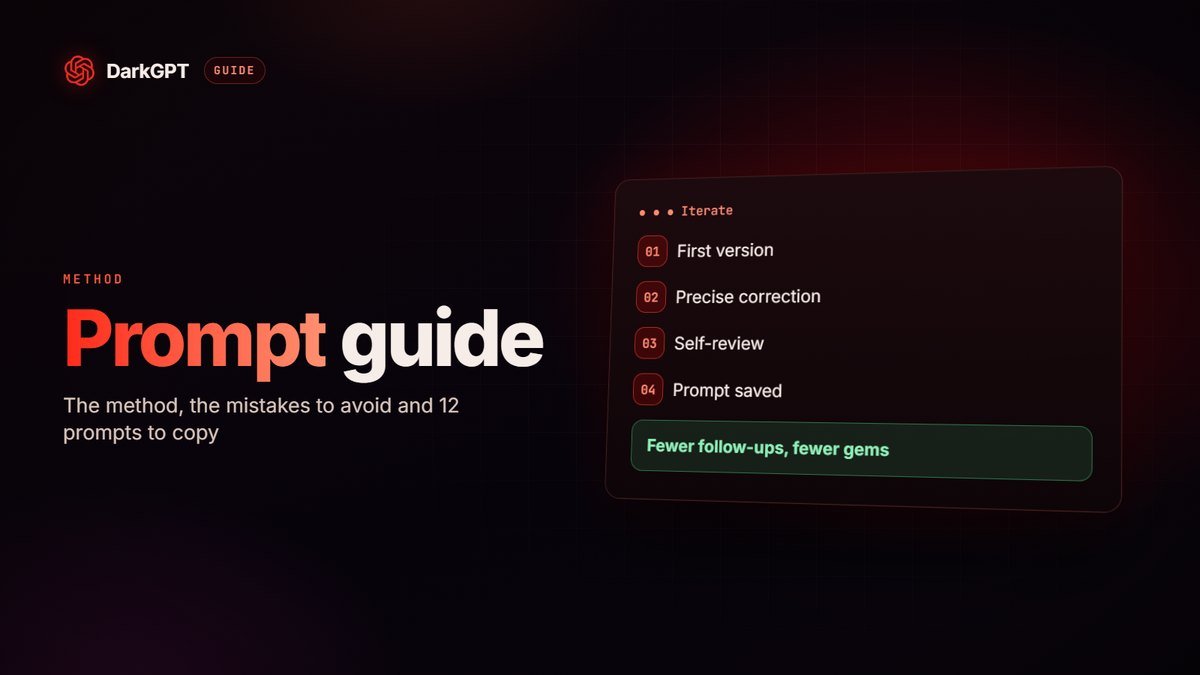
Work in six steps, one scene or chapter per message, never the whole book at once.
- The pitchDescribe your story in three sentences (character, stakes, obstacle) and ask for ten stronger versions. Keep the best and rework it by hand.
- The story bibleOne sheet per character (goal, fear, secret, way of speaking) and one for the world. You’ll paste it into every session.
- The detailed outlineChapter by chapter, with the purpose of each scene, the twist and the last line. Have Claude Sonnet 4.6 or Gemini 2.5 Pro check it.
- One chapter per messageSend the bible, a summary of what came before and the chapter outline, then ask for the text.
- Revision passesOne pass per problem. Structure first, then dialogue, then sentence rhythm, then repetition.
- Your own rewriteGo over every chapter in your own voice. That’s where the text becomes yours.
Ready-to-copy prompts
A good writing prompt sets the point of view, tense, length and what to avoid. Replace the brackets with your own details.
Novels and short stories
- “Here’s my pitch and my two main character sheets. Give me a 20-chapter outline with the stakes, the twist and the last line for each chapter.”
- “Write chapter 4 following this outline. Lea’s point of view, first person, present tense. 2,000 words. No summary at the end.”
- “Rewrite this scene 30% shorter without losing information, and make the dialogue tighter.”
Dark fiction
- “Psychological thriller for adults. Write the first interrogation between the detective and the suspect: he’s calm, polite and terrifying. Everything happens in the subtext.”
- “Rural horror: describe the arrival at the house in three paragraphs, each more unsettling than the last.”
Screenplays
- “Turn this novel scene into a screenplay scene, standard format: scene heading, action, dialogue. Keep the silences.”
- “Give me three different cliffhangers for the end of episode 2.”
Articles and blog posts
- “Outline a 1,200-word article on [topic] for [audience]: a catchy title, 5 subheadings, an intro that opens with a concrete problem.”
- “Here’s my draft: keep my tone, fix the mistakes, cut the filler and flag anything that lacks evidence.”
To sharpen your wording, check our guide to writing better prompts.
Staying consistent over a long manuscript
No AI keeps an entire novel in mind forever: the longer the conversation, the more early details slip. Four habits make up for it.
- The rolling summary: at the end of each chapter, ask for a 150-word summary. Feed the next chapters these summaries, not the full text.
- Always paste the bible: names, ages, places, verbal tics. That’s what stops blue eyes from turning green in chapter 12.
- One conversation per part: starting from a clean context beats a 200-message thread.
- A long-context model for the read-through: Gemini 2.5 Pro, MiniMax 2.7 or Llama 4 Scout to check the consistency of a big block of text.
Sample budget: a 10-scene short story
Plan on about 4,270 gems for a complete short story revised with Claude: two days of Gold or one day of Platinum.
| Step | Model | Gems |
|---|---|---|
| Pitch and detailed outline | Claude Sonnet 4.6 | 550 |
| Character bible | MiniMax M3 | 120 |
| First draft of the 10 scenes | MiniMax M3 | 1,200 |
| Revision of the 3 key scenes | Claude Opus 4.7 | 2,400 |
| Total | 4,270 |
Without Claude, the same story drafted and revised with MiniMax M3 and Mistral Medium fits in a few days of the Basic plan. Every plan is on the pricing page.
Uncensored: what DarkGPT lets you write
Thrillers, horror, war, adult romance, dystopia: mainstream AIs often refuse or pile on disclaimers. In Unfiltered mode, the AI reads your request like an adult-fiction editor.
- a killer can have real inner logic, not a cartoon villain monologue;
- a horror scene can push its tension all the way;
- adult themes are handled like literature.
Use Grok 4.2, DeepSeek v4 Pro or Kimi K2.5 for those scenes, then Claude for the final polish if you like. Adults 18+ only; illegal use remains banned by the terms.
Pitfalls to avoid
Most weak AI-assisted writing comes from a prompt that is too broad or a first draft accepted as is.
- “Write me a novel”: you get a summary in disguise. Work scene by scene.
- Keeping the first version: ask for two or three variations, then mix.
- AI tics: back-to-back metaphors, moralizing chapter endings, adjective pile-ups. Ban them in your prompt.
- Facts in articles: AI can invent a number or a source. Check before you publish.
- Rights: don’t copy an existing author’s text, and don’t put a real person in a story without their consent.
Frequently asked questions
What is the best AI for writing a novel?
Claude Sonnet 4.6 (550 gems, from Gold) for style and consistency, Claude Opus 4.7 (800 gems) for the finest revision. For drafting in volume, MiniMax M3 (120 gems) and Mistral Medium (85 gems) from Basic.
Which model for a scene Claude refuses?
Grok 4.2 Non Reasoning, DeepSeek v4 Pro or Kimi K2.5, in Unfiltered mode: they write the scene, then you can go back to Claude for the finish.
Can I write dark fiction with AI?
Yes. On DarkGPT, models in Unfiltered mode write horror, violent thrillers or adult themes without moralizing. The service is for adults 18+ and illegal use is still banned.
How do I stay consistent when writing with AI?
Paste a character bible into every session, write one chapter per message, chain chapters with summaries and use a long-context model like Gemini 2.5 Pro for the full read-through.
Can AI write a screenplay?
Yes: ask for standard format (scene heading, action, dialogue), work scene by scene and have a model like Claude Sonnet 4.6 review pacing and dialogue.
Do I own a text written with AI?
The rules vary by country and use case. The safest approach is to rewrite every passage in your own voice and never reuse another author’s text.